Balinese
Features


Origins
The Balinese was born from a spontaneous coat mutation that appeared occasionally in Siamese litters during the 1940s in the United States. For a long time, these long-haired kittens were discarded for not meeting the Siamese standard. It was breeder Helen Smith who, fascinated by these kittens, began systematically breeding them in the 1950s with the goal of establishing them as an independent breed.
The name Balinese was chosen for its association with the traditional dance of Bali, whose elegance and fluidity of movement Helen Smith considered analogous to the beauty and grace of these cats. Despite its name, the breed has no real Asian origin: it is essentially a long-haired Siamese born in America. TICA and the CFA officially recognized the breed in the 1970s.
Over time, the Javanese variety or Balinese with extended colors also emerged. In some countries these two varieties are treated as separate breeds; in others they are grouped under the Balinese name. Both share the same temperament and morphology.
Characteristics and aptitudes
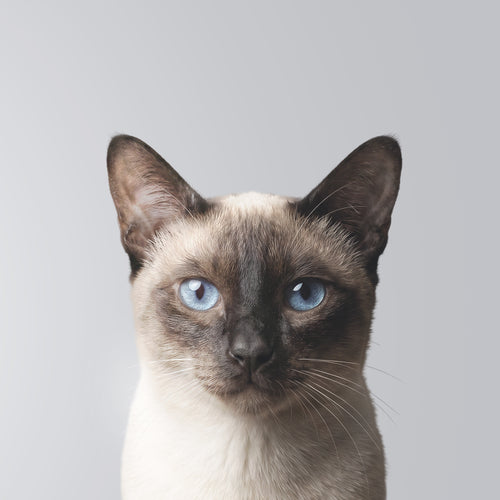
The Balinese has the classic morphology of the Siamese: long, tubular and muscular body, wedge-shaped head with large, pointed ears and eyes of an intense and hypnotic blue. What sets it apart from the Siamese is its semi-long coat, especially visible in the tail, which opens like a plume when the cat is active. The absence of undercoat makes the coat extremely silky to the touch and virtually tangle-free.
The color pattern is colorpoint: pale body with darker color points on the face, ears, paws and tail. In the classic variety the recognized colors are seal point, chocolate point, blue point and lilac point. The contrast between the pale body and dark points, together with the silky coat, creates an image of great distinction and elegance.
As for temperament, the Balinese is a very vocal, social and intelligent cat, with a voice somewhat less shrill than the Siamese. It is affectionate, active and curious, and needs to participate in everything that happens in its environment. It is very sensitive to its guardians' emotions.
Care
Caring for the Balinese coat is surprisingly simple for a semi-longhair breed. The absence of undercoat prevents the formation of tangles, so a weekly combing with a fine-toothed comb is sufficient to keep it shiny and knot-free. During molting periods, brushing can be increased to twice a week. A bath is rarely necessary.
The Balinese needs a lot of physical and mental stimulation. Tall scratching trees, shelves, interactive toys and play sessions with wand toys are essential elements for its well-being. It does not tolerate prolonged loneliness well.
The diet should be high quality and rich in animal proteins, adapted to its active metabolism and slender constitution. Access to fresh water and the combination of wet and dry diet are recommendable for optimal hydration.
Most common diseases
The Balinese, like the Siamese, may be prone to hepatic amyloidosis, a condition in which the deposition of amyloid proteins in the liver can progress to chronic liver failure. Regular blood tests are essential for early detection. Cardiomyopathy, both hypertrophic and dilated, can also affect the breed and requires monitoring through periodic echocardiographies.
Some Balinese may present mild strabismus, a condition related to the genetics of the colorpoint pattern and shared with the Siamese. Upper respiratory problems and the predisposition to certain mediastinal tumors are also documented in the Siamese lineage.
Give your Balinese the best nutrition with OnlyFresh, with high-quality proteins that support its vitality, liver health and elegant musculature, so that it accompanies you with shine, energy and joy during all its years of life.