Chartreux
Features


Origins
The Chartreux is one of Europe's oldest cat breeds, with documented references dating back to the 18th century in French texts. The most widespread legend — although not historically confirmed — attributes its origin to the Carthusian monks of the Grande Chartreuse monastery near Grenoble, who are said to have kept these blue cats for centuries as guardians of the larders and as silent meditation companions.
What is certain is that the Chartreux inhabited France's ports and merchant ships for centuries, where its dense, water-resistant coat made it an invaluable worker. The first scientific description of the breed was made by the naturalist Buffon in the 18th century, who already described its calm character and uniform blue colour as characteristic traits.
The breed nearly disappeared during the Second World War. The Léger sisters, Breton breeders, were the main drivers of its recovery from 1931 onwards, using specimens found on the island of Belle-Île-en-Mer. Today the Chartreux is recognised as a symbol of French feline heritage and is protected by strict breeding standards.
Characteristics and aptitudes
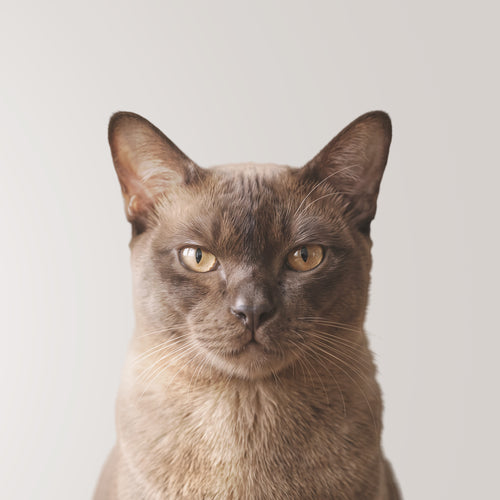
The Chartreux is a medium-to-large cat with a robust and muscular body on relatively fine legs for its build, giving it a peculiar appearance described as «a potato on sticks». The head is broad and rounded, with full cheeks and a narrow muzzle that creates the breed's characteristic smile expression. The eyes are large, round and range in colour from yellow to orange-copper, through gold.
The coat is one of the most distinctive in the feline world: short, dense and with a woolly or carded-wool texture that holds its shape when stroked. The double coat is abundant and slightly water-resistant. The colour is always blue — from pale slate blue to the most intense blue-grey — with silver-tipped hairs that create an iridescent effect.
As for temperament, the Chartreux is known for being a calm, observant and very discreet cat. It is rarely vocal: some Chartreux barely meow their whole lives. It is an intelligent cat that learns quickly and develops very deep bonds with its family, although it takes time to open up to strangers.
Care
Grooming the Chartreux's coat is moderate. Its dense double coat requires weekly brushing with a medium-toothed comb to prevent the hair from compacting and to stimulate the skin. During moulting seasons, brushing should be increased to two or three times a week. It is important not to bathe the Chartreux too frequently, as its coat has natural water-resistant properties.
The Chartreux is a moderately active cat that enjoys both interactive play and quiet rest. It likes toys that stimulate its hunting instinct. It is not a cat that needs constant stimulation, which makes it particularly suitable for quiet households or people who work away from home.
Diet should be high-quality and calorie-controlled, as the Chartreux can tend to put on weight if it does not get enough exercise. Regular veterinary check-ups, especially echocardiographies from the age of three, are essential for preventive heart health monitoring.
Most common diseases
Patellar luxation is the most characteristic condition in the Chartreux, related to its relatively fine legs for its body bulk. It can present in varying degrees of severity, from mild (barely detectable) to severe (requiring surgical intervention). Responsible breeders carry out orthopaedic tests and avoid breeding specimens with severe luxation.
Hypertrophic cardiomyopathy (HCM) is also a condition that can affect the Chartreux. Early detection through periodic echocardiographies is essential to establish the appropriate treatment and slow the progression of the disease. Serious breeders carry out annual cardiac check-ups on their breeding animals.
Give your Chartreux the best nutrition with OnlyFresh, formulated with high-quality ingredients to meet its specific needs, support its joint and cardiovascular health and keep it with the balance and serenity that define it at every stage of its life.